Wednesday, July 10, 2019

Powell Spaketh

Stocks rose on dovish comments from FED chair Powell testimony in front of the House Financial Services Committee. There is now a new 0 - 2 trend line until there isn't.

S&P500 Cash Index - 2 Hr - New 0 to 2 Trend Line

This A, B count in SP500 also recognizes that there was downward overlap in the SPY at B, as well. The current 1 / a, 2 / b is in recognition that the C wave up 'could' be starting a diagonal, but there are insufficient waves to make that claim yet.

Have a good start to your evening.
TraderJoe

Tuesday, July 9, 2019

Corrective Wave Down

So far, a corrective wave down has played out as anticipated and held above the ES 2,952 level - which would separate a "second" wave, lower, from a larger "B" wave lower. As of the cash close today, the downward wave is best counted as a double zigzag because of the unmistakable contracting diagonal we counted out live yesterday. 

SP500 Cash Index - 15 Minutes - Double ZZ

If the diagonal wave to "a" is not counted as part of a zigzag, it results either in degree violations or lack of alternation (take your pick - I want neither). But, also note that since (y) is slightly longer in both time and price than (w), then the wave could be the start of an expanding diagonal lower. And that is shown as the alternate count (i), (ii), (iii).. in red, so far.

For the diagonal to occur, however, wave (iv) must become longer in price than wave (ii), but still stay below the high of wave (ii). And those are some pretty finely structured criteria. But, the reason for mentioning it is that it could be a larger "a" wave down in a larger "B" wave lower.

Of course trading above (ii) would invalidate that alternate.

That's all for today, except we are happy to say we were ready for the price spike at the end of the day as we had earlier counted out this five-minute contracting diagonal on the Dow.


It was just a question of whether prices went under the low of the morning or over the high of the diagonal, first. They exceeded the high first - making the structure a contracting leading diagonal shown to you in near-real-time.

Have a great start to the evening.
TraderJoe

Monday, July 8, 2019

Dow Hourly

Without the overlap noted in the futures, the DOW cash index may best be counted as "five waves up" to the minute ((a)) wave, of the Y wave of Intermediate (B), as follows.

DJIA Cash Index - Hourly - Minute ((a)), Up?

Reviewing the Elliott Wave Oscillator, this is the case where the first wave is the "extended wave in the sequence", and makes the highest high for the EWO. This wave is designated as x (i). Then, each subsequent shorter wave makes a lower high on the EWO. 

I watched that Dow triangle form on a different time scale (much as  the S&P500's triangle) and it fits in this location just fine as a fourth wave triangle. In this case, the triangle's a wave is likely a flat. One leg of a triangle is allowed to be some corrective structure other than a zigzag, and this is thought to be the case for length purposes in minuet wave (iii).

If the ES futures break below 2,952 as noted previously, then this is probably the best way to count the S&P500 cash index, as well. As noted previously, there is a discrepancy in contract months on the ES futures as to whether there is overlap or not. There is not such overlap in the Dow (YM) futures.

Have a good start to your evening, and to your week.
TraderJoe

Saturday, July 6, 2019

Weekend Video Update

Here is an automated Elliott Wave Video Report prepared for any idle hours you have over the weekend.


The video may best be viewed in full-screen mode.
TraderJoe

Thursday, July 4, 2019

Holiday Video Report

Here is an automated Elliott Wave Video Report prepared for any idle hours you have over the holiday if you are in the U.S. If you are not in this country, then all the best wishes for a good week and weekend.


The video may best be viewed in full-screen mode.
TraderJoe

Tuesday, July 2, 2019

Nearing the High

Yesterday, our post included the possibility of a fourth wave triangle to better equalize the time spent in a fourth wave with the time spent in a second wave. Today's trading broke outside the channel and did create a triangle as shown on the continuing chart, below.
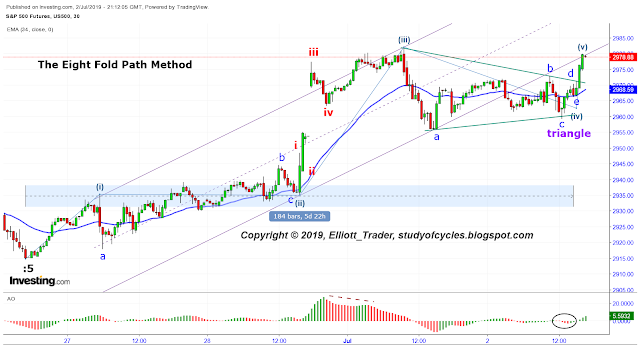
ES E-Mini S&P500 Futures - 30 Minutes - Triangle & Thrust

We counted out this triangle live and in almost real time for readers here. It is not our intent to do that often, but we wanted you to see how The Eight Fold Path Method can help predict the path of a potential impulse wave. Besides better equalizing the time between waves two & four, the triangle also helps provide alternation. Notice that the running wave (ii) has its b wave over the high of wave (i). The triangle with it's lower b wave than wave (iii) is the reason that a triangle was a good alternate for the fourth wave.

A further purpose of the triangle is to take up more time than wave (iii). And this it does, as well.

You will also note that as a cross-check, the EMA-34 shows that every significant numbered wave in the impulse - as well as the significant lettered waves in the triangle - are on an opposite side of the average which provides excellent form and balance. Notice, too, that the triangle brings the final reading of the Elliott Wave Oscillator for the fourth wave much closer to the zero mark than does that first a wave of the triangle.

At the end of the day (actually after the close of the cash session), the futures popped, and are likely providing that fifth wave. As such, wave (v) is bumping up against the underside of that channel. Does the market know that channel is there? Prices keep on being drawn to it at (i), (ii), (iii), a, b and (v). The triangle was largely expected as 'consolidation' after the first-of-the-month, and first-of-the-quarter inflows, news on trade talks and the lighter holiday volume.

At the end of the day, wave (v) is well beyond a 78% retracement - the minimum needed to claim a truncation - so even if we never see higher prices, the wave will be counted as a fifth wave.

There is another brief alternate, and that is that prices form another type of triangle from the same set of waves - and that is a "barrier triangle". This is not required, but it could happen. For that to occur, then the cash price should attempt to bang into a horizontal line drawn from wave (iii) a couple of times before popping the high. This could happen, we'll watch for it.

Have a good start to your evening.
TraderJoe

Monday, July 1, 2019

Potential Impulse ES Only

Here is a repeat of the intraday chart we showed (in the comments section today by link) on the ES E-Mini S&P500 Futures in the half hour time frame.

ES E-Mini S&P500 Futures - 30 Minutes - Potential Impulse

While the Dow Jones Industrial Average does not have this structure, and, in fact, overlapped the waves on June the 28th, with about 140 candles on the chart for the 'wave of interest', the ES futures did grab a hold of the lower channel line and rescued the plausibility of an impulse count in a channel. It is not for certain, yet, though.

Wave iii of (iii) is on the maximum of the Elliott Wave Oscillator, and wave v of (iii) is on a divergence. Wave (iv) is a sharp to potentially alternate with the very sideways wave (ii). It is possible to chew up more time, if needed, that wave (iv) could become a triangle. Further, a wave iii likely has traveled beyond the upper channel boundary to show the location of maximum momentum.

Because of how deep this wave (iv) is already, I would not want to see prices trade below 2,955 or today's low before making a new high to call the structure an impulse. If an impulse is not properly formed, then we may just have another three-wave-structure to find a home for in the wave count. But we'll provide the impulse count a good shot at it.

Have a good start to your holiday-shortened week!
TraderJoe